Last updated: April 2026
Crypto Signals That Avoid Choppy Markets
Written by SniperSignals — focused on selective signal workflows, live regime visibility, and reducing low-conviction alerts before they reach the trader.
A signal service that fires constantly is not automatically useful. In many cases, it is just pushing the filtering burden onto the trader.
Signals that avoid choppy markets aim to solve that problem by asking a harder question before a setup is surfaced: are current market conditions actually suitable for this type of signal?
SniperSignals is built around that principle. Instead of surfacing every possible setup, the system filters for conditions where the market structure is more consistent with the move being anticipated. When structure is weak, momentum is choppy, or the same zone keeps repeating, the product is designed to stand aside.
If you want crypto signals that avoid choppy markets instead of a constant blast of low-conviction alerts, the key idea is simple: the filter matters as much as the trigger. SniperSignals combines live condition checks, public signal history, and Telegram delivery into one workflow designed to be selective on purpose.
See Live Regime StatusWhat regime filtering means
Regime filtering checks the broader market environment before a signal is shown. Instead of asking only, “does this pattern match?” it also asks, “is the market in a condition where this type of pattern tends to follow through?”
A better system suppresses signals when the surrounding structure is not supportive.
That is what makes regime logic useful. It does not promise perfect timing. It simply tries to remove setups that are less likely to be worth the trader’s attention in the first place.
Why standing aside is a feature
Most signal services treat silence as a problem. If the feed goes quiet, users start wondering whether they are still getting value.
SniperSignals treats silence as a feature. Standing aside during weak or choppy conditions is one of the main ways the product avoids pushing low-conviction setups into the workflow.
Silence is often the honest response to poor structure.
How SniperSignals frames active versus suppressed conditions
The public regime page shows a table of pairs and timeframes. Each cell is labeled Active or Suppressed with a reason.
That suppressed state is not hand-wavy marketing copy. It is tied to specific reasons the system can expose.
The product is not merely saying it filters. It is exposing where it is active and where it is refusing to participate.
See the live regime page
The live regime page is public. Anyone can check which pairs and timeframes are currently active or suppressed without logging in.
That public visibility matters because it makes the selective model easier to evaluate.
You can look at the current market state, compare it with the public signal history, and decide whether the workflow feels disciplined enough to justify a trial.
Open the Regime Page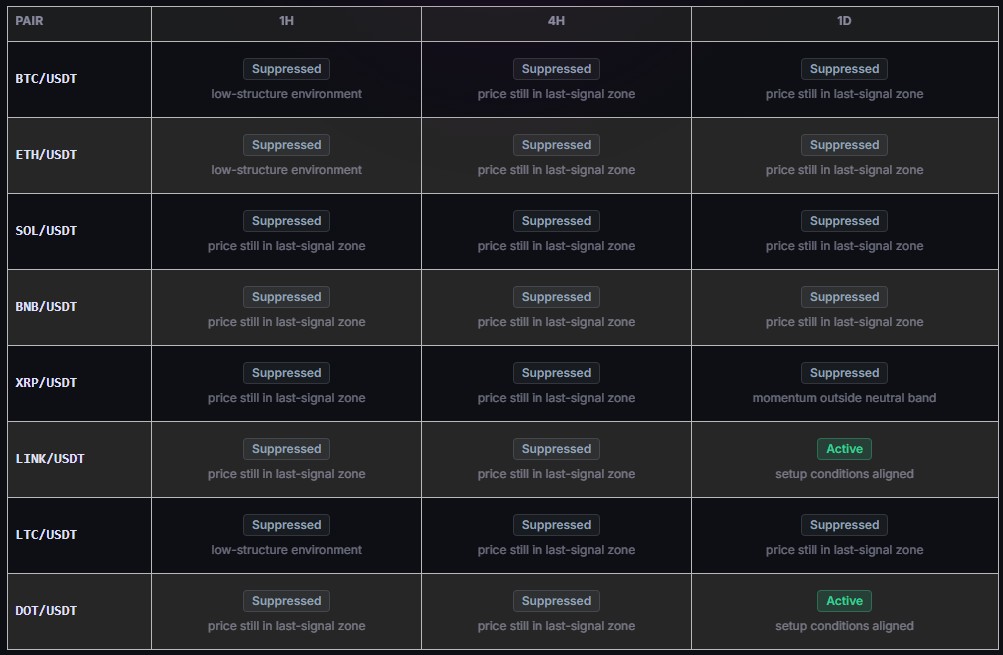
FAQ
What does regime filtering mean?
It means checking the broader market environment before surfacing a setup.
Why is standing aside useful?
Because fewer alerts can be a sign that the product is filtering noise instead of padding the feed.
Can I see the live regime logic?
Yes. The regime page is public.
Does this guarantee better results?
No. It is a filtering layer, not a guarantee.
Selective is stronger than noisy
The real test is not how often a signal service speaks. It is whether silence means the filter is doing its job.
Start Free 7-Day Trial