Last updated: April 2026
Crypto Signals With a Public Track Record
Written by SniperSignals — focused on public proof, consistent outcome labeling, and making signal workflows easier to evaluate before trust is asked for.
Most crypto signal services talk about results. Very few make those results easy to inspect. That difference matters.
In this category, “track record” often means cherry-picked screenshots, selective recaps, or a stream of winning calls with no visible accounting for the rest. That is marketing, not transparency.
A real crypto signal track record should let you answer basic questions: Do they show failed signals too? Do they explain how outcomes are classified? Can you review recent resolved signals without joining first? Is the data public enough to reduce blind trust? SniperSignals was built with that problem in mind. The product includes a public signal history page that shows resolved signals labeled as worked, mixed, or failed, along with entry, exit, timing, and outcome notes.
If you are looking for crypto signals with track record evidence instead of marketing noise, start with public proof. SniperSignals pairs a visible history of resolved outcomes with a real dashboard, Telegram delivery, and a no-account-linking workflow designed to be inspected before trust is asked for.
See Public Signal HistoryWhat “track record” usually means in this market
In the crypto signal market, “track record” is usually much looser than it sounds. Many services use screenshots of winners, recap posts in private Telegram groups, or vague win-rate claims that are impossible to audit.
That leaves the trader in a weak position. You are expected to trust the framing chosen by the service itself.
If a service says it has a track record but will only show curated winners inside a private channel, that is not a real accountability layer.
What real transparency should include
Real transparency should include the full set of resolved signals, not just the flattering ones. A trader should be able to see wins, mixed outcomes, and failures in the same place.
Just as important, that information should be visible without requiring payment first. A public signal history page is a much stronger signal of seriousness than a feed of screenshots posted after the fact.
The point is not just to show numbers. The point is to let the trader judge the whole operating system.
How SniperSignals classifies outcomes
SniperSignals uses three outcome labels. Worked means the signal moved +0.5% or more in the anticipated direction. Mixed means the result fell between -0.5% and +0.5%. Failed means the signal moved -0.5% or worse.
That consistency matters more than pretending there is some magic performance label that explains everything.
Clear criteria are still much better than soft storytelling.
Why public resolved history matters
Public resolved history lets traders evaluate before they pay. It also keeps the service accountable.
Public proof changes the tone of the buyer relationship. Instead of asking users to trust a room, SniperSignals gives them a way to inspect the evidence first.
A service that welcomes inspection before signup is making a stronger claim than one that asks for belief first and evidence later.
Open Public Track Record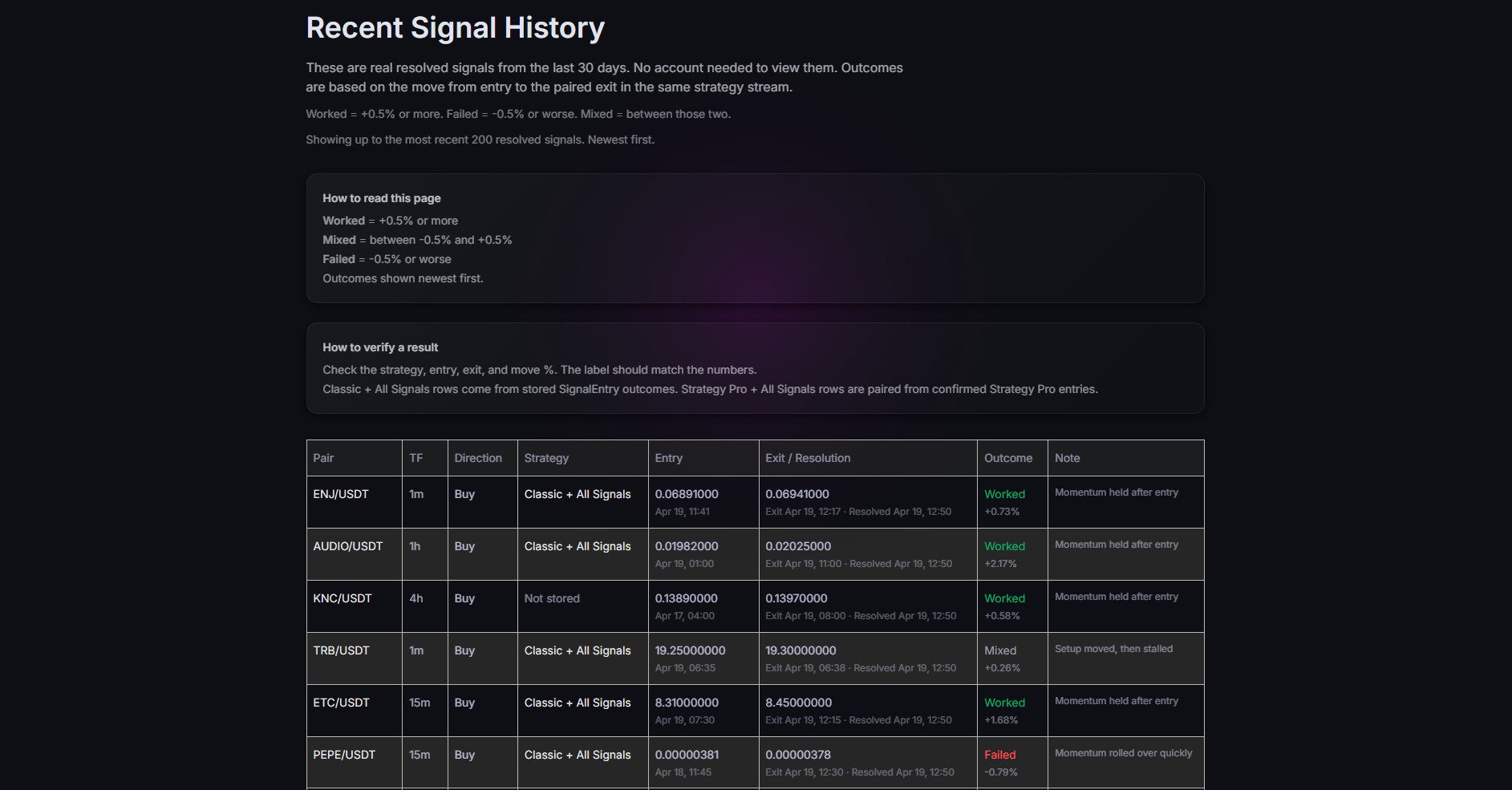
FAQ
What should a public track record include?
Wins, losses, mixed outcomes, recent resolved history, and visible rules for how outcomes are classified.
Why is public proof better than screenshots?
Because screenshots are easy to cherry-pick and hide the full record traders need to inspect.
Can I inspect SniperSignals before paying?
Yes. The public signal history is visible before signup.
Does a public record guarantee results?
No. It does not guarantee performance. It just makes the service easier to evaluate honestly.
Proof should survive inspection
If the record disappears the moment you ask where the losses are, it was never proof to begin with.
Start Free 7-Day Trial